Should You Feed Hummingbirds Through a Mild Winter?
In regions where winter stays mild, keeping a hummingbird feeder running is reasonable and often useful, because some hummingbirds spend the whole year in those areas rather than leaving. A feeder does not keep birds from going where they would otherwise go. What matters is that if you choose to feed through winter, you commit to the same standard of cleanliness you keep in summer.
Does a feeder make birds stay when they should not?
This is the worry that stops most people, and the reassurance is straightforward: hummingbirds do not decide where to spend the winter based on whether one garden has a feeder. Their movements are driven by daylight and internal cues, not by the convenience of a single food source.
What a feeder does provide is a reliable option for birds that are already staying. In mild-winter regions there are year-round residents and late-lingering individuals, and cool weather reduces the number of flowers and insects available to them. A clean feeder is a genuine help in that situation.
The decision, then, is not really about the birds' behavior. It is about whether you will keep the feeder to a proper standard through months when you are outdoors less and less inclined to do garden chores.
What changes in cool weather, and what does not
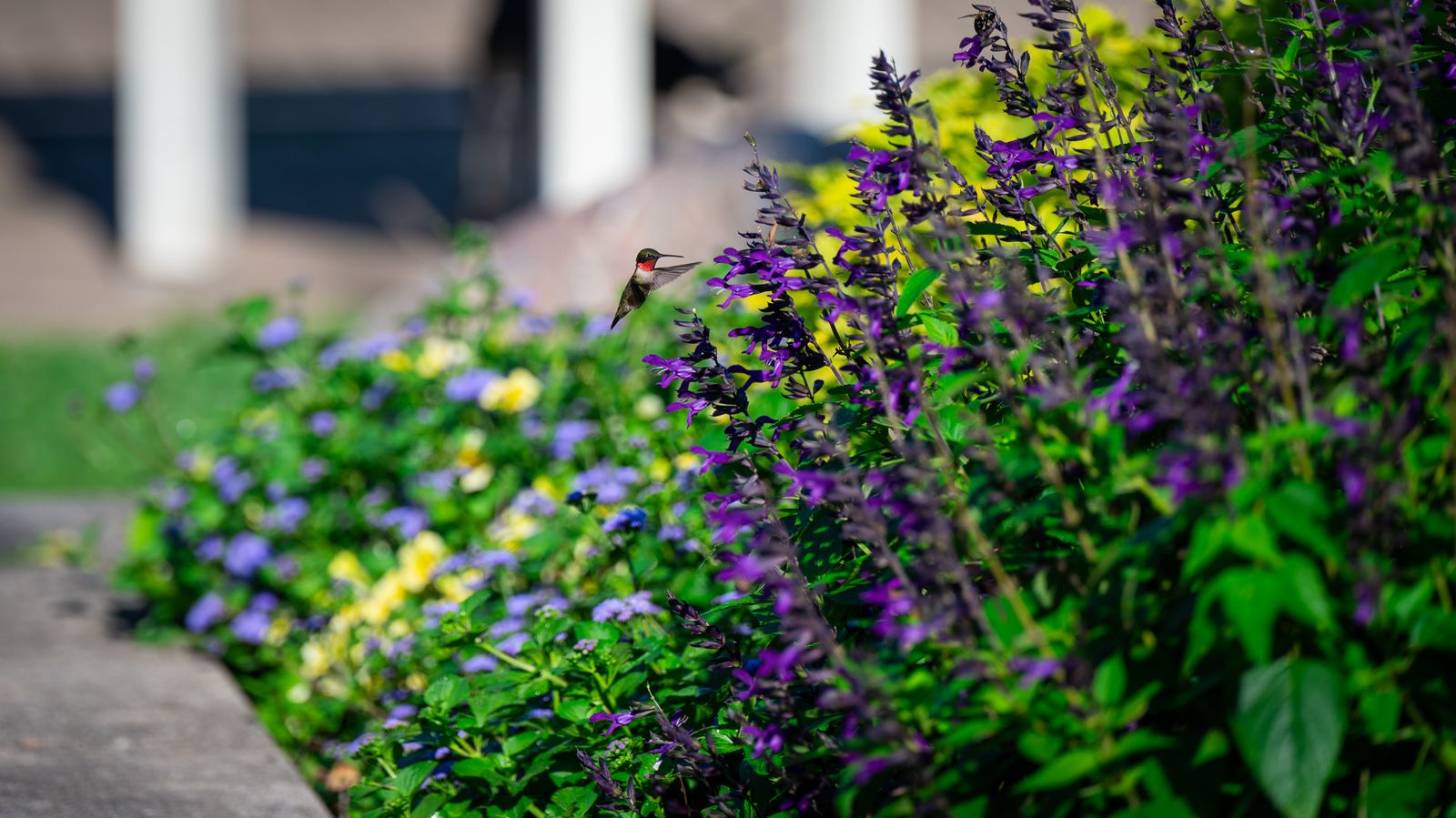
| Aspect | Warm months | Mild winter | |---|---|---| | Nectar recipe | One part white sugar to four parts water | Unchanged, one part sugar to four parts water | | Change frequency | More often, driven by heat | Less often, but still on a schedule | | Cleaning standard | Thorough every change | Identical, no relaxation | | Traffic level | Higher | Lower, often a few regulars | | Volume needed | Full reservoir | Often less, but do not let it run dry | | Solar charging | Long days, strong light | Short days, weaker light | | Additives | None | Still none |
Two rows are worth emphasizing. The recipe never changes: plain white sugar and water, with no red dye, no honey, and no brown sugar, in winter exactly as in summer. And the cleaning standard never relaxes, even though slower spoilage tempts people to stretch the interval indefinitely.
The cool-weather routine
The last point is the practical trap. In summer, evaporation, heat, and heavy traffic force your hand. In winter, a feeder can sit visibly full for a long stretch, and a full feeder feels like a feeder that does not need attention. It does.
Handling a brief freeze in an otherwise mild region
Mild-winter regions still get occasional cold nights, and nectar can slush or freeze in those windows. The practical answers are simple and require no special equipment.
Bring the feeder indoors overnight when a freeze is forecast, and put it back out at first light. Birds feed in daylight, so an overnight absence costs them nothing. Alternatively, keep a second reservoir indoors and swap them in the morning so there is always a thawed one ready.
Do not add anything to the nectar to lower its freezing point. There is no safe additive for this, and the correct solution is temperature management rather than chemistry. Also check the base and cap after a freeze. Liquid expands as it freezes, and a reservoir left out through a hard night is being stressed in a way it is not designed for.
Material matters for exactly this reason, and the durability comparison of hand-blown glass and plastic hummingbird feeders is worth reading before you leave any reservoir out through cold nights.
Less light means less lighting
Winter days are shorter and the sun sits lower, so a feeder that charges itself collects less energy. A model that lights for up to eight hours after a full recharge will run for a shorter stretch in December than in June, and that is normal rather than a fault.
You can improve it. Move the feeder to the sunniest available position for the winter months, which is often farther from the house and clear of the long shadows that low sun throws from walls and fences. Wipe the solar cap clean of dust, pollen, and rain marks, since a dirty cap collects less light. And accept a shorter run of illumination as the season's limit rather than assuming something needs replacing.
The cap earns its keep in other ways in winter. A plastic solar cap that shields the reservoir from sun, rain, and snow keeps water out of the nectar during wet weather, which matters more in winter than in summer.
Deciding whether to feed at all
Feed through the winter if all of the following are true. Your region genuinely has mild winters rather than sustained hard freezes. You are willing to keep a fixed cleaning schedule for months when the feeder looks untouched. And you can manage the occasional cold night, either by bringing the feeder in or by swapping reservoirs.
Skip it if you cannot commit to the cleaning. A neglected winter feeder is worse than an empty hook, because a bird that has learned to rely on it finds spoiled nectar rather than none.
A middle path works well: keep flowering plants that bloom in the cooler months alongside a feeder you maintain properly, so the garden is not dependent on a single source. The trade-offs are covered in the comparison of live nectar plants and glass solar feeders, and cool-season planting is where that combination pays off most.
FAQ
Will a feeder stop hummingbirds from leaving for the winter? No. Their movements are driven by daylight and internal cues rather than by one garden's food supply. Birds that stay in mild-winter regions are staying regardless of your feeder.
Should the nectar be made stronger in cold weather? No. Keep one part plain white sugar to four parts water year-round. Stronger mixes and additives are not a cold-weather adjustment, they are a risk.
How often should winter nectar be changed? Less often than in summer heat, but still on a fixed schedule you decide in advance and keep. Cool weather slows spoilage, it does not stop it, and residue still builds inside the ports.
What should be done on a freezing night? Bring the feeder in overnight and put it back out at dawn, or keep a spare reservoir indoors and swap them each morning. Never add anything to the nectar to keep it liquid.
Where to start
Look honestly at your own winter: how many nights actually drop below freezing, and whether you will keep a cleaning schedule through a quiet season. If both answers are favorable, move the feeder to the sunniest spot you have and set a recurring day in your calendar for the change. That one calendar entry is what makes winter feeding work.
Cover photo by Veronika Andrews on Pexels.