Do Solar Lights Bother Hummingbirds at Night? Everything You Need to Know
A small solar light on a hummingbird feeder does not bother hummingbirds, because hummingbirds leave feeders at dusk and roost in sheltered cover well away from where they eat. They are strictly daytime feeders, and many enter a deep nightly rest to conserve energy, so they are not sitting at a lit feeder overnight. The reasonable precautions are about the garden generally: keep light aimed at the feeder rather than flooding the shrubs and trees where birds actually sleep.
When do hummingbirds stop feeding for the day?
Around dusk. Hummingbirds feed by sight, they need to see the flowers and ports they are aiming at, and their entire day is organized around taking in enough energy before dark. As light fades, activity at a feeder drops off quickly and then stops.
After that, they move to a roosting spot. That is usually a thin branch inside dense shrub cover or tree foliage, chosen for shelter from wind and concealment from predators, and typically not the feeder itself. Many hummingbirds also enter torpor overnight, a deep rest in which body temperature and metabolic rate drop sharply, which is how such a small bird survives a night without eating.
The practical implication is straightforward. A light at the feeder is shining on hardware, not on a sleeping bird.
So what is the light for?
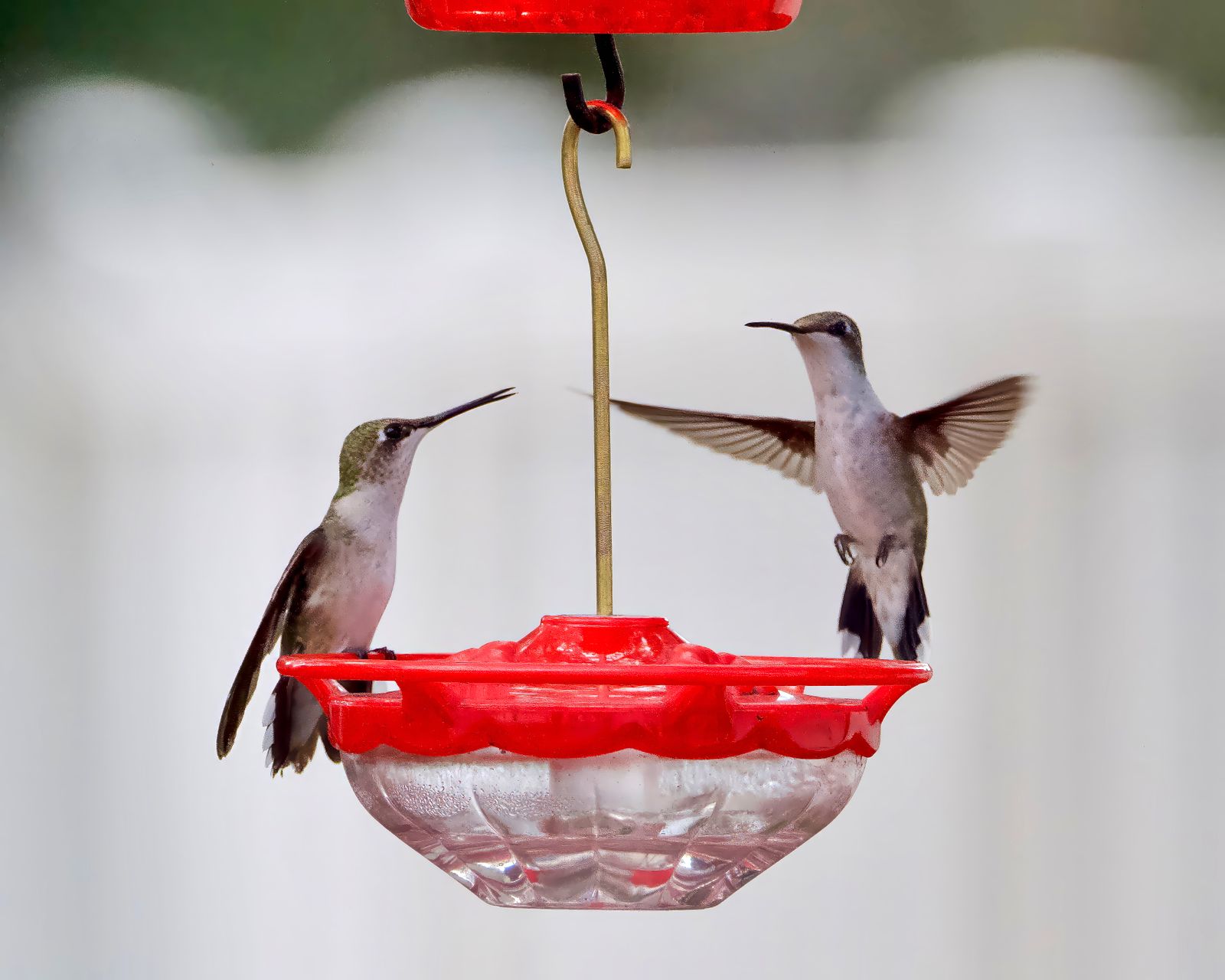
Photo by A. G. Rosales on Pexels
You. A solar cap charges through the day and switches on automatically at dusk so the feeder reads as a piece of illuminated glass rather than vanishing into the dark. On the feeder sold here, that means RGB lights with multiple lighting mode options, lit automatically at night for up to 8 hours after a full recharge, glowing through a hand-blown, translucent glass reservoir.
No feeder light attracts hummingbirds at night, because there is no nighttime hummingbird activity to attract. Any claim otherwise is describing behavior these birds do not have. What the light does is make an evening patio more interesting, and that is a perfectly good reason to want one.
What lighting near a garden can genuinely affect
The honest concerns with outdoor lighting are not about a small feeder lamp. They are about scale, direction, and duration, and they mostly involve other wildlife:
- Roost disturbance. Bright light aimed directly into dense shrubs or hedges can unsettle roosting birds of many species. The fix is aiming, not abstinence.
- Insects. Bright white light draws night-flying insects, which is why warm and colored light is generally the friendlier choice around a garden.
- All-night floodlighting. Continuous, high-output light across an entire yard is a different proposition from a small decorative light that runs for part of the evening and then goes out on its own.
- Nocturnal wildlife. Moths, bats, and other night animals navigate by very low light levels, and heavy garden lighting affects them more than it affects daytime birds.
Light behavior and what it means in a garden
| Choice | Effect on daytime birds like hummingbirds | Practical note | |---|---|---| | Small solar light on a feeder | No meaningful effect; birds have already gone to roost | Runs on stored charge and switches off when it is spent | | Colored or RGB light | No meaningful effect | Tends to draw fewer night insects than bright white | | Steady or slow color change | No meaningful effect | More pleasant to sit beside than fast flashing | | Light aimed into dense shrubs and hedges | Can disturb roosting birds of various species | Aim at the feeder, not into cover | | Full-yard floodlights left on all night | The genuine concern for garden wildlife | Use motion sensors or timers if you need them |
Five sensible practices for a lighted feeder
What actually matters more than the light
Photo by Chait Goli on Pexels
Nectar quality and cleaning make far more difference to hummingbird health than any lighting decision. This is where attention belongs.
Mix one part plain white granulated sugar into four parts water, stir until fully dissolved, and let it cool before filling. Do not add red dye; it serves no purpose for the birds. Skip honey, brown sugar, and artificial sweeteners as well, since plain sucrose in water is what these birds are built to process.
Empty, wash, and refill every few days, and more often in hot weather or any time the nectar looks cloudy or shows dark specks or film. Hot water and a bottle brush are enough. Scrub the ports and the sealing surfaces, and rinse well before refilling. Mold and fermentation in sugar water are real hazards, and they develop faster in heat.
A see-through reservoir helps a great deal here, because you can see the nectar rather than guessing. Being able to read the level and the clarity from across the patio is one of the underrated practical benefits of a translucent glass feeder, and the material differences behind that are covered in this look at glass versus plastic on aesthetics and durability.
Does a lighted feeder affect where birds feel safe during the day?
Not through the light, which is off in daylight, but placement affects daytime comfort quite a bit. Hummingbirds like a nearby perch, ideally a thin branch within a few yards, where they can rest between visits and watch the feeder. They also prefer a feeder that is not pressed against a wall or deep inside a hedge where a predator could be waiting.
A feeder with a foot of clearance on all sides, a perch nearby, and some overhead cover a short flight away tends to get used more consistently than one crammed into a corner. That geometry also keeps ants from walking across onto the feeder from a fence or trunk.
If you want to make the daytime side of the yard more attractive, plantings and feeders complement each other rather than competing, and this comparison of live nectar plants and glass solar feeders breaks down what each contributes.
FAQ
Do hummingbirds ever feed at night? Essentially no. They are day-active birds that feed by sight and stop at dusk. A very rare bird in an unusual situation, such as one near strong artificial light in cold weather, is the exception that proves the rule rather than a behavior to plan around.
Should I turn the feeder light off during migration? There is no need for a small solar feeder light. The lighting concern during migration involves tall, brightly lit structures and large-scale floodlighting that can disorient birds flying at night. A low decorative light in a garden is a different scale entirely.
Do the colors matter? Is red light better or worse? Color makes little difference to roosting daytime birds. Where color does matter is insects, since bright white light attracts more night-flying insects than warmer or colored light. Pick the mode you enjoy sitting beside.
Will the light stay on all night? Not usually, and that is a feature. A solar light runs on the charge collected that day, so it lights the part of the evening you are outside and then goes out. Overcast days give you a shorter run.
A practical next step
Hang the feeder in the open where you can see it, aimed so the glow stays on the glass rather than washing into hedges and dense shrubs, and put your effort into a strict nectar-change routine. The light is a garden decision; the nectar is the bird decision, and that is the one worth being rigorous about.
Cover photo by Veronika Andrews on Pexels.