Keeping Squirrels and Larger Birds Away From a Nectar Feeder
Squirrels and larger birds go after nectar feeders for the sugar, and the fix is almost always placement rather than a gadget. Move the feeder out of jumping range, put a baffle above or below it, and choose a mount that offers no landing platform. Ports sized for a hummingbird's bill already exclude most bigger visitors from drinking, so the real damage is knocked-down feeders and spilled nectar.
Why they show up at all
Nectar is concentrated sugar and easy calories. A squirrel that finds it will return on a schedule, and so will orioles, woodpeckers, jays, and starlings, all of which are heavy enough to tip or unseat a hanging feeder even when they cannot feed from it.
That distinction matters for choosing a response. A squirrel is trying to get at the liquid and will chew, pry, and swing to reach it. A larger bird is usually just landing, failing to feed, and leaving, but its weight sets the feeder rocking and pushes nectar out through the ports. One problem calls for exclusion, the other for stability.
Spilled nectar is the compounding cost. It draws ants, wasps, and more squirrels, and it turns the ground under the feeder into a sticky patch that has to be rinsed. Solving access usually solves the mess at the same time.
Placement beats hardware
The single most effective change is distance from launch points. A squirrel can leap a surprising horizontal gap and drop farther still, so a feeder hanging near a fence rail, deck post, tree trunk, or low roof edge is effectively unprotected no matter what hardware you add.
Aim for a feeder suspended in open air, roughly an arm's span clear of any vertical surface and well above the ground, with nothing directly overhead within jumping distance. A shepherd's hook or freestanding pole in open ground achieves this easily. A bracket screwed to a deck post rarely does.
Mount type does most of the work here, and the trade-offs between hanging from a branch, a hook, or a pole are worth thinking through before you start adding accessories to a location that was never defensible.
Comparing the common deterrents
| Approach | Stops squirrels | Stops large birds | Notes | |---|---|---|---| | Move away from launch points | Very effective | Somewhat | Free, and it fixes the root cause | | Baffle above the feeder | Effective on tree hangs | No | Blocks the drop-from-above route | | Baffle below on a pole | Very effective | No | Blocks the climb-up route | | Smooth metal pole | Effective | No | Nothing to grip on the way up | | Small ports sized for slim bills | Not the point | Effective | Larger bills cannot reach the nectar | | No perches on the feeder | Somewhat | Effective | Removes the landing platform entirely | | Greased poles or sticky coatings | Avoid | Avoid | Harms fur and feathers, do not use | | Capsaicin or additives in nectar | Avoid | Avoid | Never add anything to plain nectar |
Two rows in that table are hard rules rather than preferences. Never grease a pole and never add anything to nectar to make it unpleasant. Nectar stays as one part plain white sugar to four parts water, with no dye, no honey, and no brown sugar, and that does not change because a squirrel found the feeder.
Feeder design features that help
- Port size. Feeding ports shaped for a hummingbird's slender bill exclude thicker-billed birds from drinking, even when they land.
- No wide perch ring. A feeder without a broad perch gives larger birds nowhere to settle, so they leave quickly.
- A sealed base. A design with a sealed base and a slender profile minimizes drips and spills, which means less sugar on the ground and fewer repeat visitors.
- Weight and rigidity. A reservoir with real mass, such as hand-blown glass on a metal base, rocks less than a very light one when a heavy bird lands.
- A solid cap. A plastic solar cap that shields the reservoir from sun, rain, and snow also covers the top surface, removing an obvious place for a larger bird to perch and pry.
A five-step exclusion routine
Skipping step one is the most common mistake. People buy a pole baffle for a feeder that is being raided from an overhanging branch, then conclude that baffles do not work.
What not to do
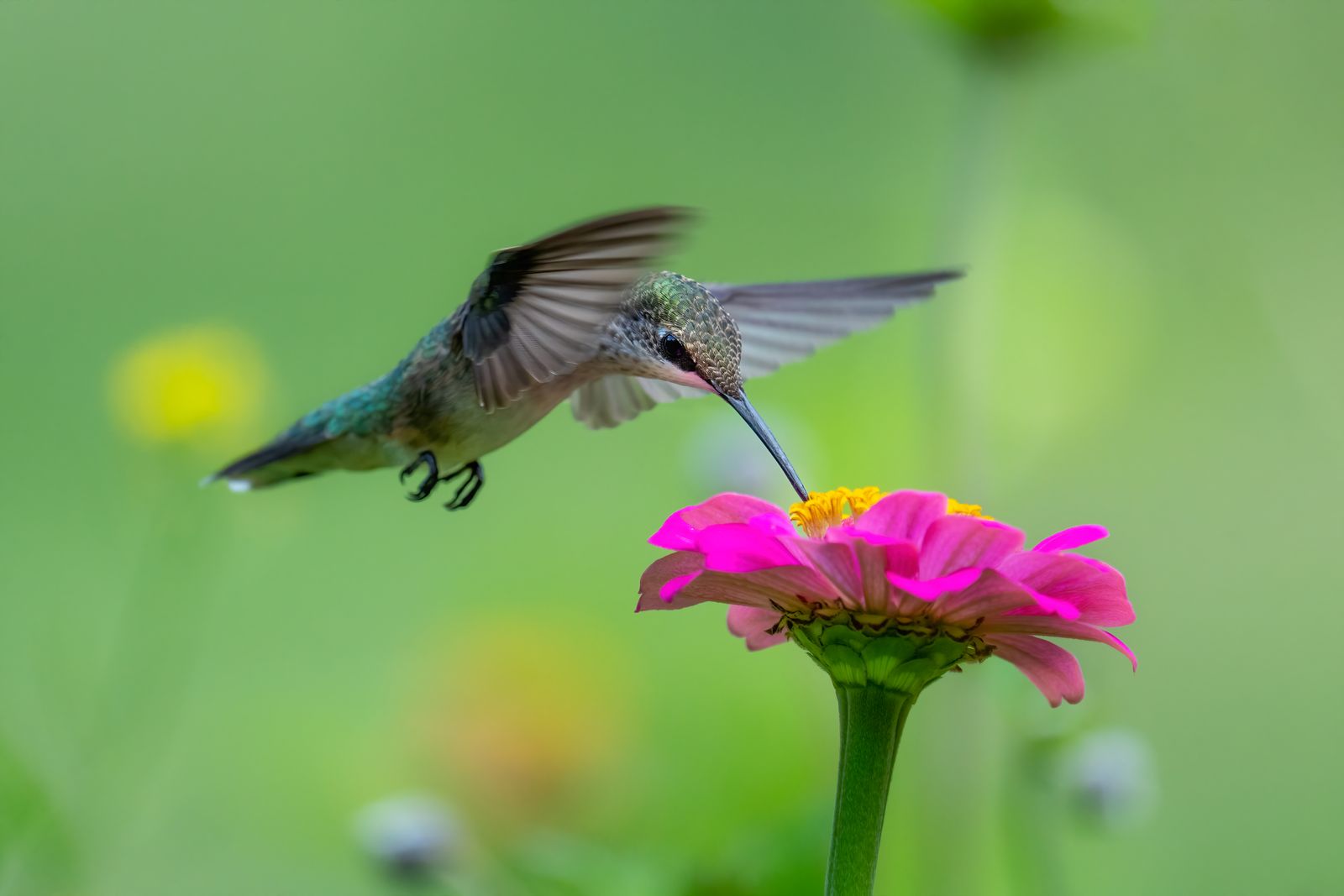
Photo by Skyler Ewing on Pexels
Do not trap, poison, or harm squirrels, and do not use adhesive or greasy coatings that damage fur and feathers. Beyond the ethics, an injured animal near a feeder is a problem you now own.
Do not shrink the feeder's capacity or skip refills as a deterrent. An empty feeder loses hummingbirds long before it discourages a squirrel, and hummingbirds are slow to return to an unreliable source.
Do not stop feeding altogether over a single squirrel. Persistent raiders are usually solved by one relocation and one baffle, and the feeder itself is rarely the problem.
Living with the ones you cannot exclude
Some gardens are surrounded by mature trees with no genuinely open spot. In those, aim for damage limitation rather than perfect exclusion. Choose a feeder with a sealed base and narrow ports so a knock costs you very little nectar, use a rigid hanger so the feeder cannot spin free, and check the mount weekly for chew marks and loosened hardware.
It also helps to give hummingbirds an alternative that squirrels ignore entirely. Nectar-bearing plantings serve birds without offering a raidable reservoir, and the practical differences between live nectar plants and a glass solar feeder explain how to combine the two in a yard with heavy squirrel pressure.
FAQ
Will squirrels actually drink the nectar? Some will reach the ports and lick spilled liquid, and a determined one may chew at a cap to get more. The bigger cost is usually the feeder being knocked down and emptied rather than what gets drunk.
Do large birds fit through hummingbird ports? Generally not. Ports sized for a slender bill exclude thicker-billed birds from feeding, though they can still land, perch, and rock the feeder enough to spill.
Is a baffle above or below better? Above for anything hanging from a branch or overhead structure, below for a pole or shepherd's hook. Match the baffle to the route the animal is actually using.
Can anything be added to the nectar to deter them? No. Nectar should be plain white sugar and water only. Additives risk harming the birds you are feeding, and there is no safe version of this approach.
Where to start
Spend ten minutes watching rather than shopping. Once you know whether the raider drops in from above, climbs the mount, or leaps from a rail, the fix is usually a short relocation plus one baffle, and it holds for the rest of the season.
Cover photo by Chris F on Pexels.