Going Away for a Week: A Practical Plan for Your Hummingbird Feeder
For a trip of a few days in mild weather, a clean feeder filled with fresh nectar can usually be left as it is. For anything longer, or for hot weather, either arrange for someone to change the nectar or take the feeder down, clean it, and leave it empty. A feeder full of spoiled nectar is worse for birds than no feeder at all.
The rule that decides everything
Nectar spoils on a schedule set by temperature, and it spoils whether or not anyone is home. That single fact drives every decision here. Fermented, cloudy nectar and residue inside the ports are harmful to birds, so the goal is never to leave a full reservoir standing longer than it would safely last while you were there.
Work out how often you currently change the nectar in the weather you are leaving behind. If your trip is shorter than that interval, you can leave a freshly filled feeder and walk away. If it is longer, you need either a helper or an empty feeder. There is no third option that involves leaving it and hoping.
Being able to see the level through the glass makes this easier to judge, and a large reservoir helps with volume, but capacity does not extend freshness. A feeder with a 32 fl.oz capacity holds more nectar, not fresher nectar.
Decision table by trip length and weather
| Trip length | Mild weather | Hot weather | |---|---|---| | One to two days | Fill fresh and leave | Fill fresh and leave, expect to change it on return | | Three to five days | Fill fresh and leave, clean on return | Arrange a nectar change, or take it down | | Six days to two weeks | Arrange a nectar change | Arrange a nectar change, or take it down | | Longer than two weeks | Take it down, clean, store empty | Take it down, clean, store empty |
Read the table as a floor, not a ceiling. If you are unsure whether a helper will actually follow through, taking the feeder down is the safer choice in every row.
Before you leave: a seven-step routine
That last step is easy to skip and expensive to skip. A feeder that falls on day two of a trip spills sugar across the ground and greets you with a week-old mess.
Briefing a neighbor or sitter
Keep the instructions to one page and make them mechanical. Most people who agree to help have never mixed nectar and will do exactly what you write down, no more and no less.
- What to do: empty the old nectar, rinse the reservoir with hot water, refill with the pre-measured batch, and rehang.
- How often: give a specific day of the week, not "when it looks low."
- The recipe: one part plain white sugar to four parts water. Write it out. Add explicitly that no dye, honey, or brown sugar goes in.
- What to leave them: measured sugar in a labeled container, a clean bottle brush, and a spare feeder cap if you have one.
- What not to worry about: the level dropping. That is the feeder working.
- When to stop: if anything looks cloudy, stringy, or dark, empty it, rinse it, and leave it empty until you return.
If you take the feeder down instead
Taking it down is not a failure. It is the standard answer for long trips and for hot-weather absences with no reliable helper.
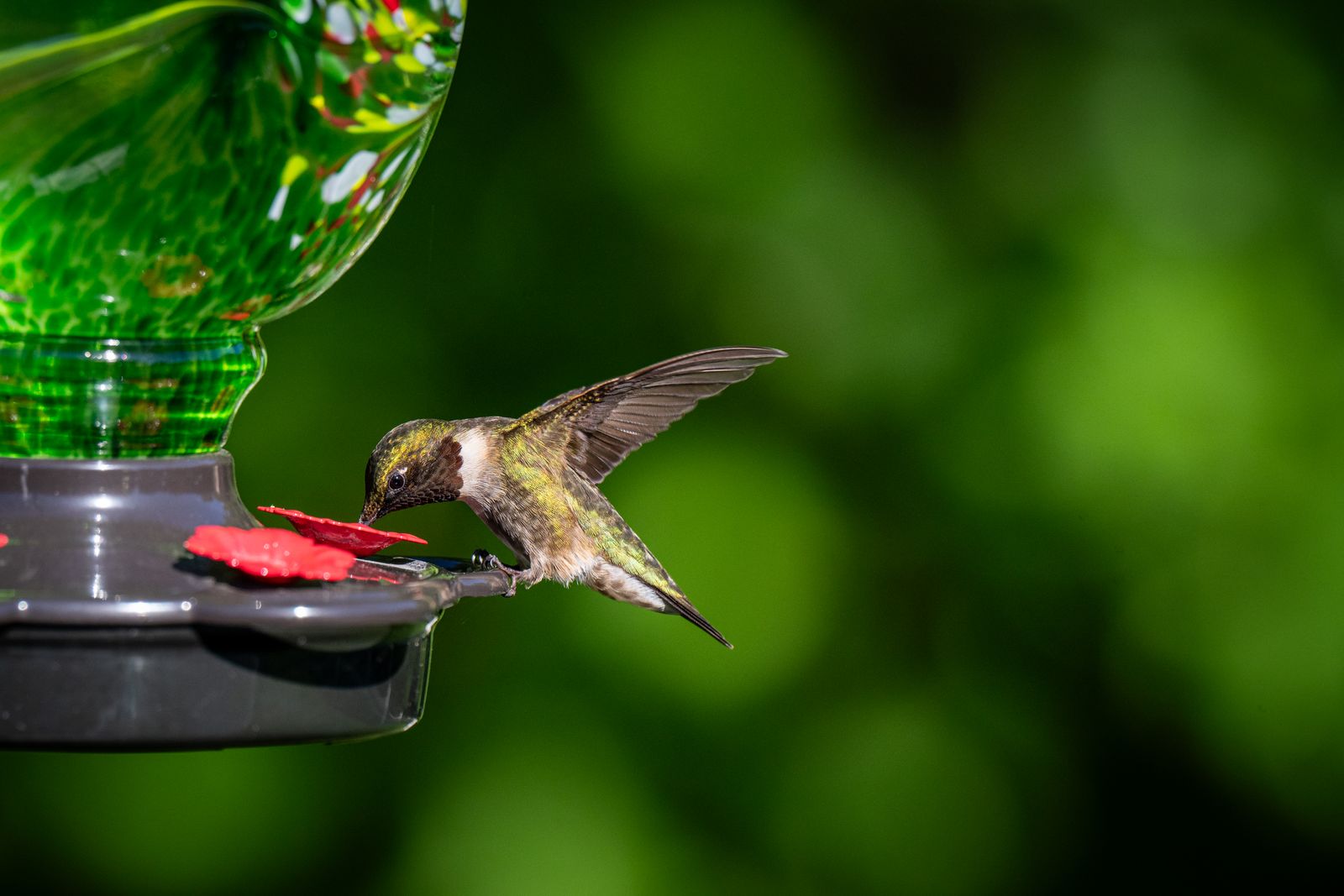
Empty the reservoir, wash and rinse every part, and let it dry fully before storing. Store the glass reservoir somewhere it cannot be knocked, wrapped or boxed rather than balanced on a shelf, since a hand-blown reservoir is the part you cannot easily replace. The durability differences between glass and plastic feeders are most obvious in storage and handling rather than in normal use.
If the feeder has a solar cap, store it somewhere with some light rather than a sealed dark box, and expect the first night back to be dimmer until the cap has had a full day of sun. A model that lights for up to eight hours after a full recharge needs that recharge before it performs.
Birds cope with a feeder disappearing better than with a feeder full of spoiled nectar. Established planting helps here too, which is part of the argument for keeping live nectar plants alongside a glass solar feeder rather than relying on the feeder alone.
Coming home: how to restart
Treat the feeder as dirty regardless of how it looks. Take it down, empty whatever is inside, and wash the reservoir, cap, and ports with hot water before refilling. Nectar that has stood for a week can leave a film that is invisible until you scrub it.
Check the ports individually. Residue dries into the openings and can partly block them, which shows up as birds probing and giving up rather than as anything obvious to the eye. Refill any ant moat with fresh water.
Then be patient. Birds that found other sources during your absence may take a few days to work the feeder back into their route. Keep the nectar fresh through that period rather than letting a slow week become a reason to skip a change.
FAQ
Can a feeder be left full for two weeks if it is large enough? No. Capacity affects how much nectar is there, not how long it stays safe. Spoilage is driven by time and temperature, so a large full reservoir left for two weeks is a large amount of spoiled nectar.
Will hummingbirds leave for good if the feeder disappears? They will use other sources while it is gone and generally return once it is back and reliable. A short gap is far less damaging than fermented nectar.
Is it better to half-fill the feeder before a trip? Half-filling reduces waste but does not change the spoilage clock, and it means the feeder runs dry early. Fill normally for short trips and take it down for long ones.
Can a sitter just top it off instead of emptying it? No. Topping off adds fresh nectar to old and leaves residue in place. The instruction should always be empty, rinse, refill.
Where to start
Look at your trip dates, look at the forecast, and compare the gap to how often you normally change the nectar. If the trip is longer than that interval and no one can reliably help, clean the feeder and store it empty. That decision takes twenty minutes and removes every other worry on the list.
Cover photo by Chris F on Pexels.