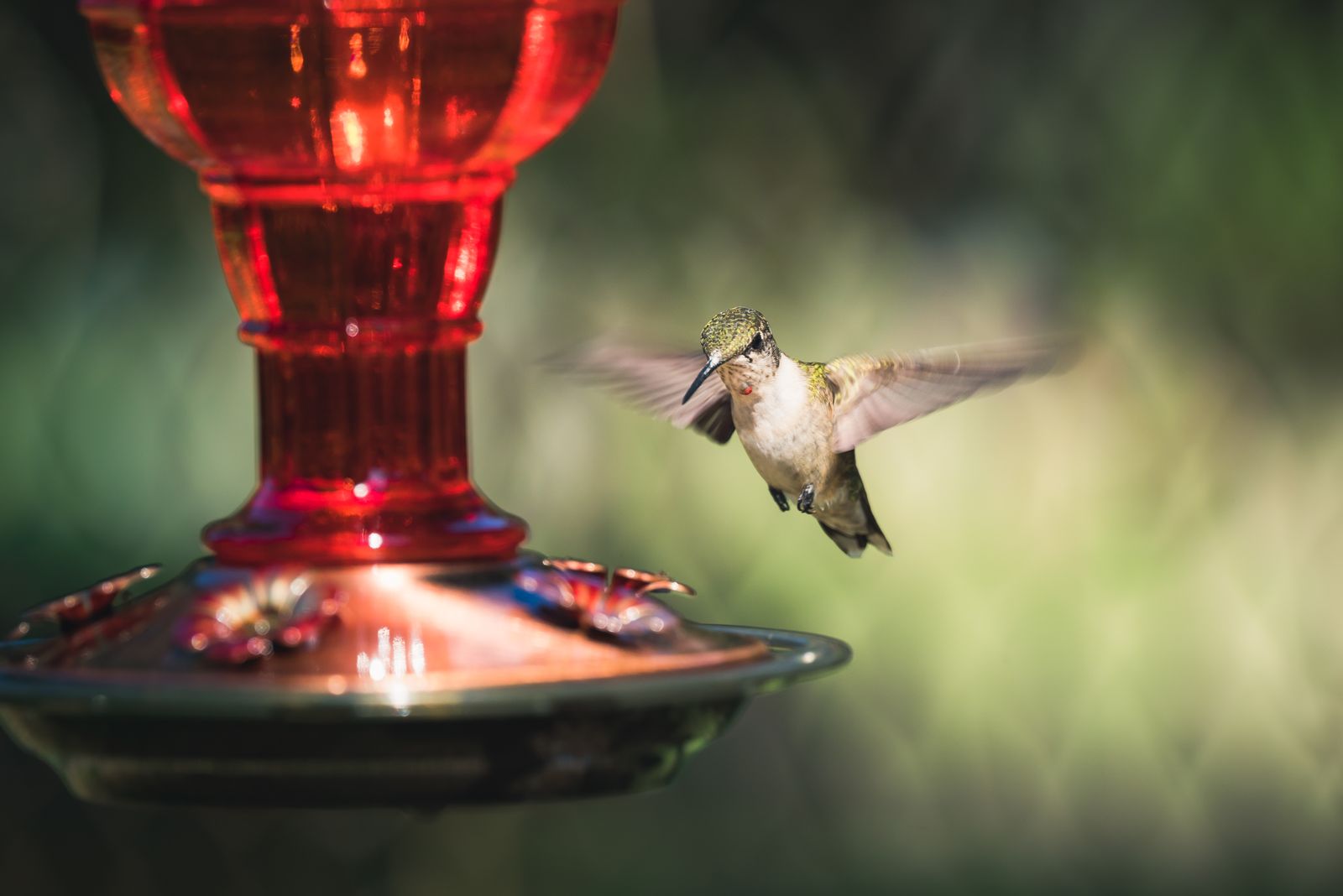
Setting Up a Hummingbird Feeder in a Very Small Courtyard
A very small courtyard can support a hummingbird feeder as long as you solve three things: a mount that does not need soil, a position that keeps drips off paving, and enough daylight for a solar cap in a space surrounded by walls. One feeder is the right number in a courtyard, and where you put it matters far more than which model you choose.
What makes a courtyard different
A courtyard is enclosed, paved, and shaded for part of the day by its own walls. Those three facts change every decision. There is often no ground to push a hook into, spills land on hard surfaces where sugar stays sticky, and the sun tracks across the space for fewer hours than an open yard receives.
The enclosure also works in your favor. Walls block wind, so a feeder hangs still, and hummingbirds are notably tolerant of small spaces near buildings when the approach is unobstructed and there is somewhere to perch.
Size does not mean birds will not come. It means you get one good position rather than several, so the position has to be right the first time.
Choosing a mount with no soil to work with
| Mount | Needs soil | Stability | Best courtyard use | |---|---|---|---| | Wall bracket | No | High | The default for a paved courtyard | | Pole in a weighted base | No | High | Freestanding spot away from walls | | Shepherd's hook in a large planter | No | Moderate | Works if the planter is heavy and deep | | Ceiling or pergola hook | No | High | Covered courtyards and porch corners | | Hook pushed into a paving gap | No | Poor | Avoid, it will lean and drip | | Railing clamp | No | Moderate | Only if it holds the feeder well clear of the rail |
A wall bracket is usually the answer. Fix it into something structural, position it so the feeder hangs clear of the wall rather than against it, and check that you can reach the feeder comfortably for refills without a step stool.
If you use a planter, weight is what keeps the hook upright. A deep, heavy pot filled with damp soil holds a hook well; a light plastic pot does not, and a full reservoir will tip it.
Placement in a space with only one good spot
Work backward from where you sit. In a courtyard the viewing position is fixed, so place the feeder eight to twelve feet from that seat, high enough to be above eye level, and offset so you are not looking straight into a wall behind it.
Then check three things in order. Is there a clear flight approach from above or from the courtyard entrance, so birds are not threading between furniture? Is the feeder away from a doorway where people pass constantly? And is it clear of the surfaces cats can sit on, which in a walled space includes the wall tops themselves.
Keep the feeder away from the corner where two walls meet. Corners feel tidy but limit approach angles and trap heat, and heat is already a courtyard problem.
Handling drips on hard surfaces
This is the failure mode people do not anticipate. In a lawn, a few drops of nectar disappear. On flagstone, tile, or concrete, they dry into a sticky patch that attracts ants and wasps and stains over a season.
- Choose a feeder with a sealed base and a slender shape that minimizes drips and spills rather than one that weeps at every port.
- Position it over a planted bed, a gravel strip, or a large potted plant instead of directly over the main paved area.
- Refill over a bucket or a sink indoors, never in place. Most spills happen during handling, not during feeding.
- Rinse the paving under the feeder with plain water once a week during warm weather.
- Use an ant moat with plain water only, and top it off when it evaporates, which happens faster in a hot enclosed space.
Working with limited sunlight
Walls steal hours of sun. If the feeder charges itself during the day, map the light before choosing the bracket position: stand in the courtyard at mid-morning, midday, and late afternoon and note where direct sun actually falls.
The best courtyard position is often higher up a wall than instinct suggests, because upper walls clear the shadow line earlier and hold sun longer. A feeder that lights for up to eight hours after a full recharge needs that daylight, and a bracket placed in the courtyard's permanent shade will light for a much shorter stretch.
There is a trade-off with heat. A small paved space with sun on it gets hot, and warm nectar spoils faster, so expect to change nectar more often than a shaded yard would require. Mix it plain, one part white sugar to four parts water, with no red dye, no honey, and no brown sugar, and change it on the shorter schedule that heat demands.
Planting helps on both counts, giving shade, perches, and an additional draw. The practical differences between live nectar plants and a glass solar feeder are especially relevant in a courtyard, where a few well-chosen containers can do the work of a whole border.
A courtyard setup procedure
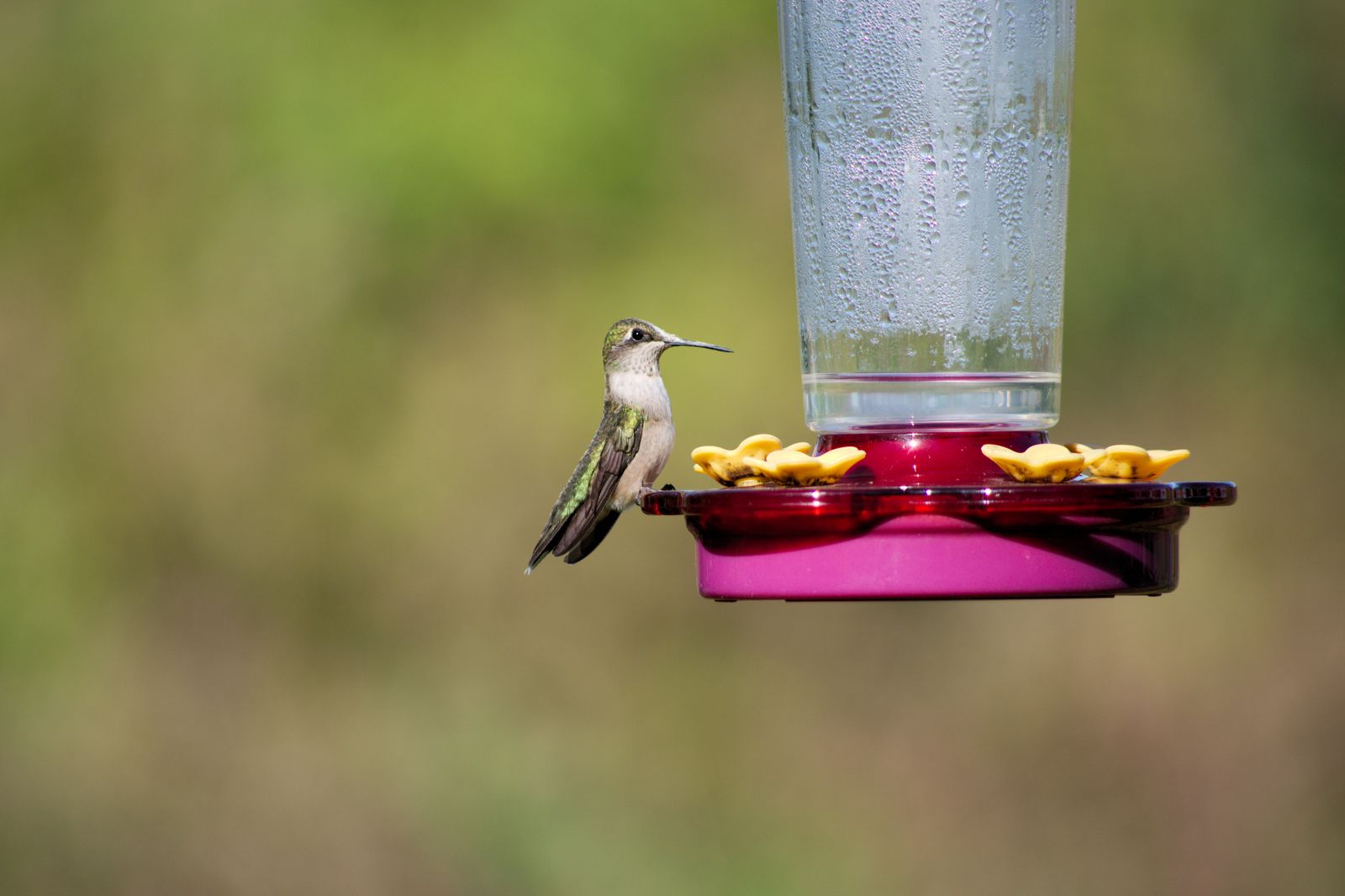
Photo by Sean Ewing on Pexels
Choosing a feeder that suits a confined space
In a courtyard the feeder is furniture. It sits within a few feet of where people sit, at eye level, in a space with little else competing for attention, so appearance carries more weight than it would across a lawn.
That argues for a reservoir with genuine visual interest. A hand-blown glass reservoir, shaped individually so no two pieces match, reads as an object rather than a fixture, and translucent colored glass catches courtyard light through the day. A model with RGB lighting and multiple mode options doubles as evening lighting in a space that often has none.
Weight and handling deserve thought too, since a courtyard means carrying a filled reservoir across hard surfaces. The durability and aesthetic comparison of hand-blown glass and plastic feeders covers what each material means for handling and for how the piece looks up close.
FAQ
Will hummingbirds come to a walled courtyard? They will, provided there is a clear approach and the feeder is visible from above or from the entrance. Small enclosed spaces are not a barrier if the flight path is not blocked by furniture or dense overhead structure.
Is one feeder enough in a small space? Yes. A courtyard rarely has room to separate two feeders out of sight of one another, so a second one splits traffic and doubles the cleaning for no benefit.
How do you stop nectar staining the paving? Hang the feeder over a planter or gravel strip, refill it indoors over a sink, and rinse the surface beneath it weekly in warm weather.
Does a shaded courtyard rule out a solar feeder? Not necessarily, but partial shade means less charge and a shorter run of light. Mount higher on the wall where sun clears the shadow line earlier in the day.
Where to start
Spend one day noticing where the sun actually lands on your courtyard walls, then pick the highest point in that band that you can still reach comfortably. That single observation settles the mount, the sightline, and the maintenance rhythm at once.
Cover photo by Chris F on Pexels.