Creating an Enchanted Summer Twilight: How to Style Solar Accents and RGB Feeder Lights
A summer garden that looks magical after dark is built from three or four light sources at different heights, not from a dozen identical stake lights in a row. Pick one glowing object as the focal point, add low path light for safety, wash one plant or wall for depth, and leave the rest of the yard dark so the lit parts read as deliberate. A hand-blown glass hummingbird feeder with RGB lighting works unusually well as that focal point, because the colorful translucent glass carries color through the whole reservoir instead of just throwing a beam.
Start with where you sit, not where the plants are
The first decision in evening lighting is the viewing position. Sit in the chair you actually use at 9 p.m. and look out. Everything you light should be visible from there, and nothing you light should shine back into your eyes from there.
This one habit prevents the most common outcome, which is a yard full of lights that looks great from the upstairs window and glaring from the patio. Glow you look at is charming; glow that looks at you is a headache. A lit feeder is easiest to place well because the light source sits inside a diffusing glass body, so the effect is a soft lantern rather than a point of glare.
The three layers of an evening garden
Photo by A. G. Rosales on Pexels
Think in layers instead of fixtures. Each layer does a different job, and a summer yard only needs one or two items per layer.
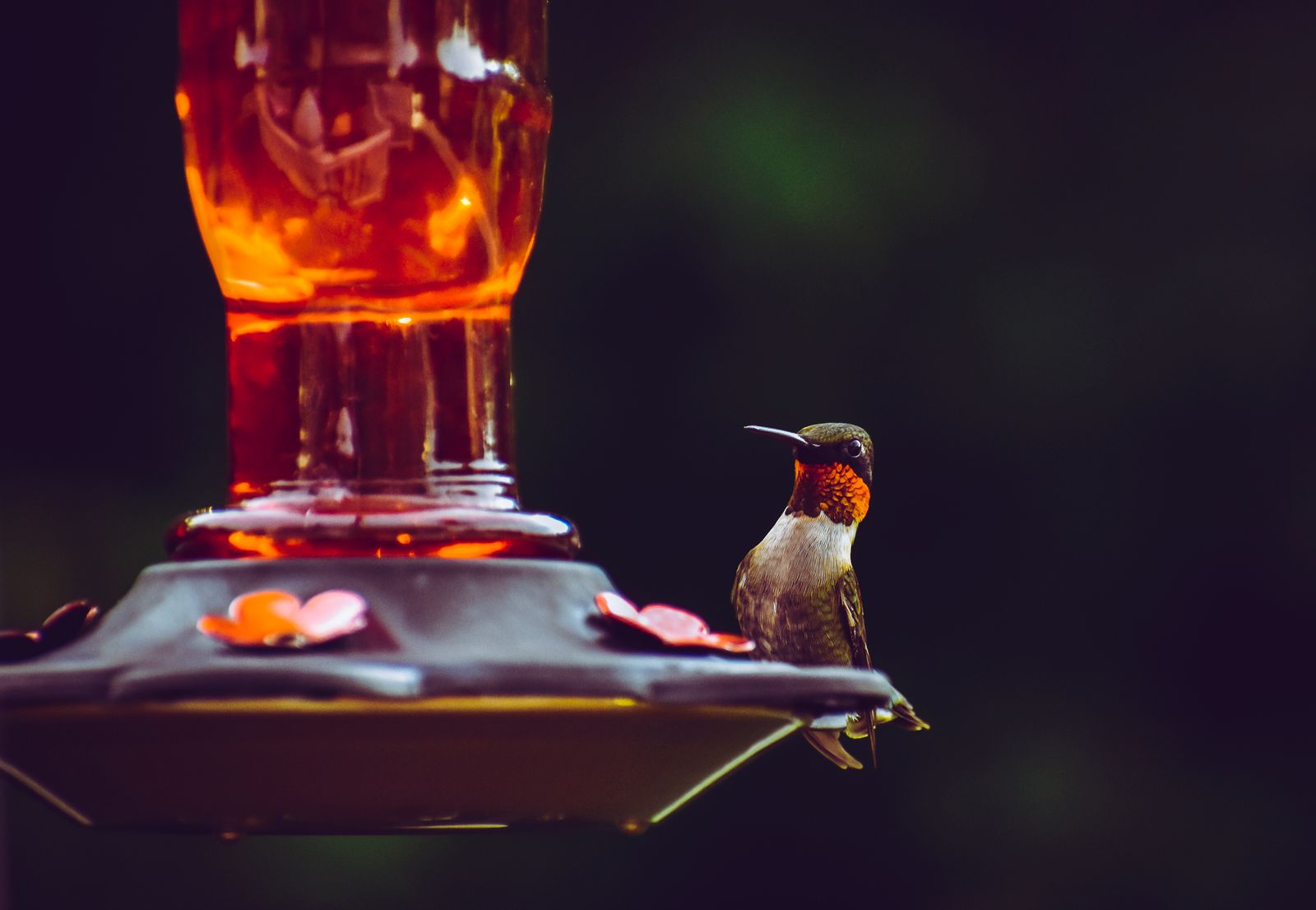
- Focal layer, roughly 3 to 5 feet off the ground. One object that holds the eye. A glowing glass feeder hanging at eye level from a shepherd's hook or a low branch is ideal, since it reads as both sculpture and function.
- Ground layer, below knee height. Path and step lighting, kept dim and spaced generously. This layer is about safe footing, not decoration; too much of it flattens everything else.
- Depth layer, above head height or against a vertical surface. A single uplit tree trunk, a string of warm lights under a pergola, or light grazing a fence. This is what keeps the garden from ending at the edge of the patio.
- Optional accent layer. Something with motion or change — water, a slow color cycle, candlelight. One accent per garden. Two competing accents cancel each other out.
What makes a glass feeder work as the centerpiece
Most solar garden lights point light outward. A glass reservoir does the opposite: it holds light. Because each reservoir is hand-blown, shaped by artisans working glass at 2,300 degrees, the curves and patterns are unique to that piece, and light passing through them lands differently than it would through molded plastic.
Practical placement notes that follow from that:
Choosing colors that flatter a summer garden
RGB lighting gives you multiple modes, and restraint is what separates a garden from a storefront. Summer foliage is overwhelmingly green, and green sits next to blue and yellow on the color wheel, which is why cool blues read as calm and warm ambers read as inviting against it.
| Mode choice | Best for | Watch out for | |---|---|---| | Fixed warm color | Dinner outdoors, small patios, anywhere people are talking | Can disappear against warm-toned brick or terracotta | | Fixed cool blue or teal | Hot nights, modern planting, water features | Reads cold if it is the only light in the yard | | Slow color cycle | A single focal piece with dark backdrop | Two cycling objects in view at once looks restless | | Fast or multi-color modes | Parties, holidays, kids' evenings | Too busy for everyday use in a small space | | Whatever your neighbors see | Front yards and shared fences | Bright cycling light aimed across a property line |
The general rule: cycle one thing, hold everything else steady.
A step-by-step plan for one summer evening
This is a single-afternoon project that gets you a finished look without buying a system.
Mistakes that make a lit garden look cheap
Even spacing. Lights at regular intervals read as a parking lot. Cluster them where something is worth seeing and leave gaps.
Too many colors at once. Three cycling color sources in one view fight each other. One is a feature.
Lighting the lawn. Grass gives nothing back at night. Light plants with texture, water, glass, or bark instead.
Ignoring daytime looks. Solar fixtures sit in your garden for 14 hours of daylight before they ever light up. A glass reservoir that is beautiful at noon is doing double duty; a plastic housing that is invisible at noon is not. The comparison of hand-blown glass and plastic feeders goes deeper on that difference.
FAQ
Will an illuminated feeder still attract hummingbirds during the day? Yes. Daytime attraction comes from the feeder's visibility, fresh nectar, and nearby flowers — not from the light, which runs after the birds have roosted. Use one part plain white sugar to four parts water, and no red dye.
How high should a glowing feeder hang? Roughly 4 to 5 feet is a good default. That is close to eye level from a seated position, high enough to stay clear of cats and lawn traffic, and low enough to reach for refills without a ladder.
Can solar lighting handle a stretch of cloudy summer days? Partly. Bright overcast still charges the cap, just more slowly, so expect shorter evenings after gray days. Wiping dust and pollen off the cap recovers more run time than most people expect.
Do I need a power source or a timer? No. Solar hardware charges during the day and switches on by itself at dark, which is why it suits a garden with no outdoor outlet. There is nothing to schedule.
A practical next step
Take one photo of your garden from your seat at full dark tonight, before changing anything. Then hang a single focal light and take the same photo again. The comparison shows you exactly how little it takes, and it stops the slow drift toward over-lighting. If you want the daytime half of the garden pulling its weight too, the look at live nectar plants next to glass solar feeders covers which plantings do the most work.
Cover photo by Claudia Rodriguez Casas on Pexels.