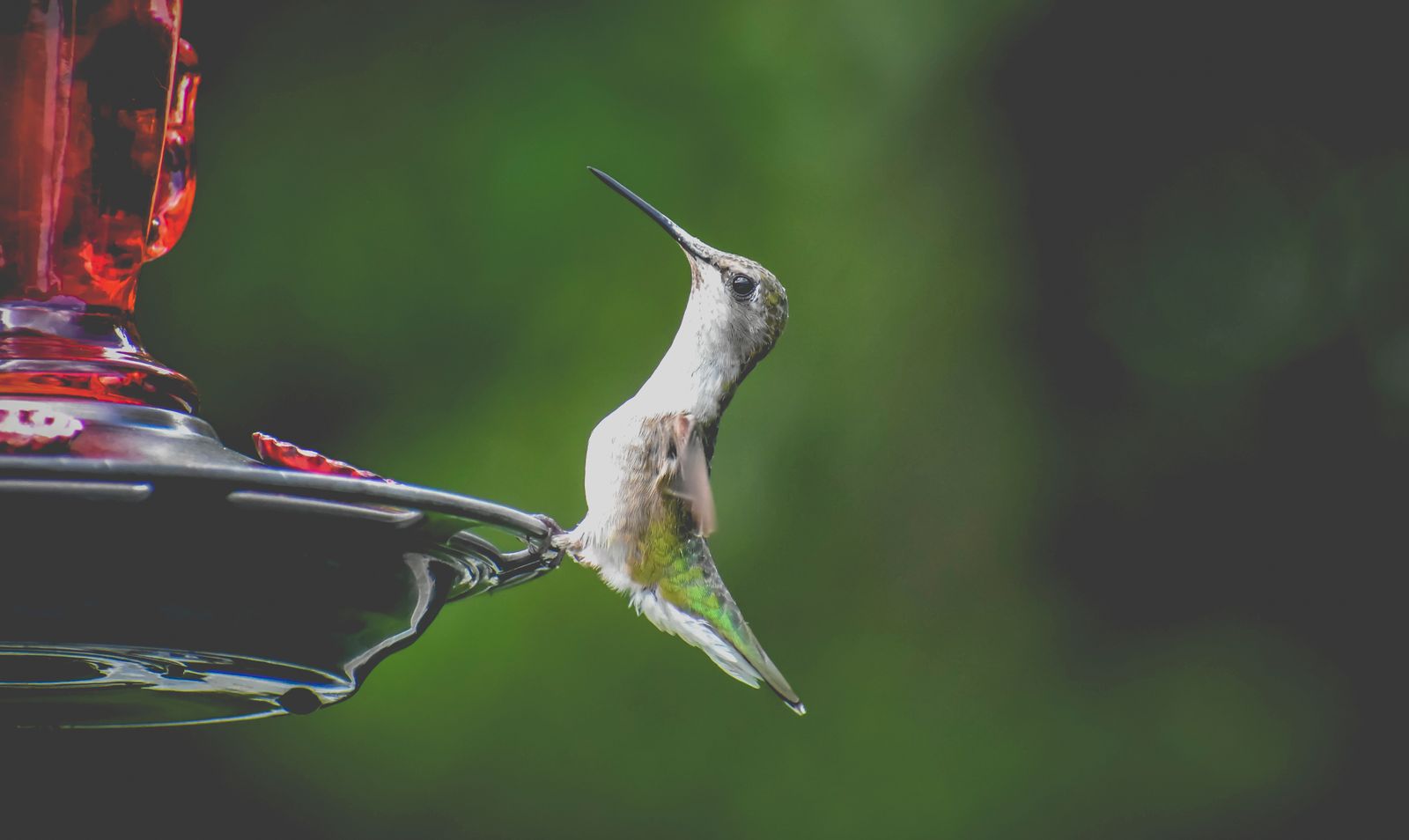
The Science of Sealed Base Mechanics: How Hand-Blown Glass Feeders Prevent Nectar Waste
A sealed-base hummingbird feeder holds nectar in an inverted reservoir and releases it only as fast as birds drink it, because trapped air and the weight of the liquid stay in balance. The sealed base is the gasketed collar and feeding-port assembly that closes the bottom of the reservoir, and it is the one part that decides whether a feeder drips all afternoon or stays dry for days. Once the mechanism is clear, it becomes obvious why some feeders waste half their nectar on the lawn while others empty almost entirely into birds.
How does a sealed-base feeder hold nectar upside down?
Fill the reservoir, tighten the base, invert the feeder, and a small amount of nectar runs down into the ports and then stops. Gravity is still pulling on the liquid, but as the nectar settles, the air pocket above it expands very slightly, and its pressure falls just below the atmospheric pressure outside. Outside air pressing up against the small port openings is now enough to support the weight of the nectar column above it.
The liquid only moves when something disturbs that balance. A hummingbird's tongue draws nectar out of the port, and an equal volume of air has to bubble up past the opening to replace it. That is why you sometimes see a single bubble travel up through the reservoir after a bird feeds. Surface tension across the narrow port helps too: the smaller the opening, the more the liquid film resists breaking and spilling.
People often call this a vacuum-seal hummingbird feeder, which is a reasonable shorthand but not literally accurate. There is no true vacuum inside, only a partial pressure difference of a fraction of a pound per square inch. That small difference is all the system needs, and it is also why a small leak anywhere in the base collapses the whole arrangement instantly.
Why the seal, not the glass, determines whether a feeder leaks
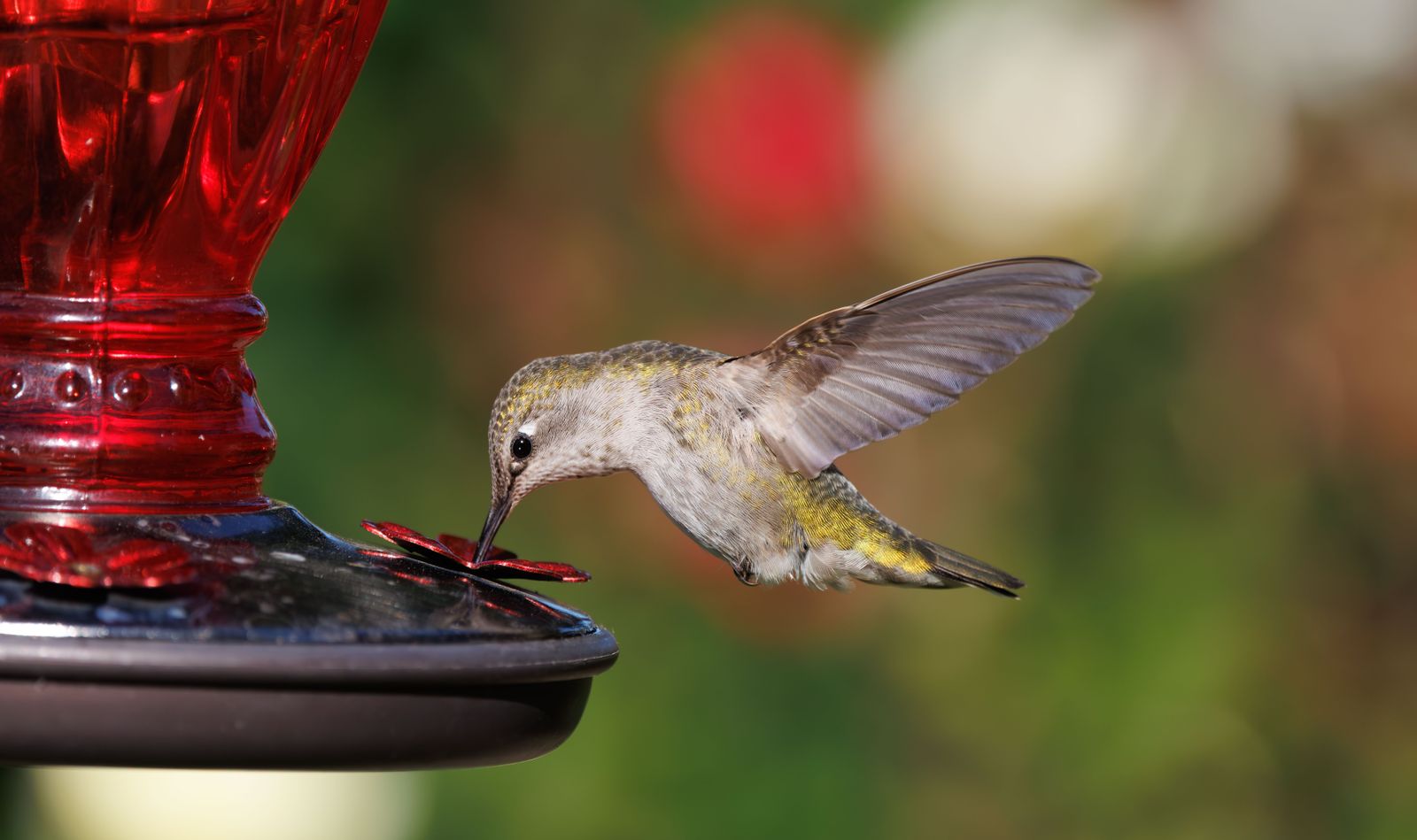
Photo by Veronika Andrews on Pexels
The reservoir is a container. The base is the machine. If air can sneak in anywhere except through the feeding ports, the pressure balance is lost, air enters the top of the liquid column freely, and nectar runs out of the ports under nothing but gravity. That is the difference between a feeder that loses a few drops on a windy day and one that dumps a third of its contents overnight.
Three things at the seal matter most:
- The gasket or washer. It has to sit flat in its groove with no grit, dried sugar, or hair across it. A single crystallized sugar ridge is enough to hold the surfaces a hair apart.
- The mating surfaces and threads. Cross-threading a base is the most common self-inflicted leak. The base should turn on smoothly and stop firmly, not squeak and bind.
- The port openings themselves. Ports need to be small, clean, and undamaged. A chipped or enlarged port lets air in past the liquid film.
What actually makes a sealed feeder start dripping
Almost every leak traces back to one of these, in rough order of how often it happens:
Sealed base vs. saucer vs. loose-fit bottle: which wastes less nectar?
| Design | How it holds nectar | Typical waste behavior | Best suited to | |---|---|---|---| | Sealed-base inverted reservoir | Partial vacuum above the liquid, ports below | Very low when the seal is clean; can drip in strong direct sun if overfilled | Gardeners who want visible nectar level and larger capacity | | Saucer (dish) feeder | Nectar sits in an open basin below the ports | Almost no dripping, but faster evaporation and rain dilution | Very hot, sunny spots and bee-heavy yards | | Loose-fit or worn bottle feeder | Intended as sealed, but air enters past the collar | High; steady drip that also draws ants and wasps | Nothing, once it reaches this state |
How to test a sealed base in five minutes
Does capacity change how much nectar you waste?
Photo by Veronika Andrews on Pexels
Indirectly, yes. A larger reservoir is convenient, but nectar spoils on a schedule set by the weather, not by how much you poured. A 32 fluid ounce feeder like the hand-blown glass model on this site gives you room to serve a busy yard, and the translucent glass lets you read the level from a distance. In quiet weeks, the smarter move is to fill only a few inches and top up more often, so nothing sits long enough to cloud.
Placement matters just as much as hardware. A feeder hung in dappled shade stays cooler, so the air pocket expands less and the nectar keeps longer. If you are still deciding where feeders fit alongside plantings, this look at how nectar plants and glass solar feeders compare for drawing birds in is a useful starting point.
Nectar and cleaning basics that reduce waste
Mix one part plain white granulated sugar into four parts water, stir until fully dissolved, and let it cool to room temperature before filling. Skip red dye entirely; it does nothing to attract birds and there is no reason to serve it. Skip honey, brown sugar, and artificial sweeteners as well.
Empty, wash, and refill every few days, and more often in hot weather, whenever the nectar looks cloudy, or if you see any black specks or film inside the reservoir. Mold is the real risk with sugar water, and a see-through reservoir is genuinely useful here because problems are visible early rather than after the fact.
FAQ
Is a sealed-base feeder harder to clean than a saucer feeder? It takes a little more attention because the reservoir is deep and the collar has threads and a gasket. A long bottle brush and a small brush for the ports handle it in a couple of minutes. The payoff is far less dripping between cleanings.
Should the base be as tight as possible? No. Tighten until the gasket compresses and the base stops turning easily, then stop. Forcing it past that point can distort the gasket or damage the threads, which creates the exact leak you were trying to prevent.
Why does my feeder drip only in the afternoon? That is thermal expansion. The trapped air warms, pressure rises, and nectar is pushed through the ports. Leave an inch of air space when filling and move the feeder somewhere it gets morning sun and afternoon shade.
Do ants and bees cause leaks? They do not cause them, but they find them fast. A steady drip is an advertisement, so treat any insect crowd as a signal to inspect the gasket and ports rather than only treating the insects.
A practical next step
Take your feeder down, run the five-minute water test above, and note where it hangs and how much sun it gets between noon and four. Most nectar waste turns out to be a crusted gasket or a too-sunny hook, both of which you can fix this weekend without buying anything.
Cover photo by Chris F on Pexels.