
Hand-Blown Glass vs. Molded Plastic Solar Feeders: Which Belongs in Your Magical Garden?
The real difference between a hand-blown glass solar feeder and a molded plastic one is not durability or looks — it is how each object was made and what that means for owning it. A molded feeder is one of thousands of identical units from a steel tool, designed to hit a low price and be replaced. A hand-blown feeder is a single piece shaped by a person at 2,300 degrees, which makes it unrepeatable, more expensive to produce, and worth keeping for years. Which one belongs in your garden depends on whether you are buying equipment or buying something you want to look at.
Two manufacturing paths, two kinds of object
Injection molding works by melting polymer and forcing it into a hardened steel mold under pressure. The mold costs a great deal to cut and then produces near-identical parts for pennies each. Everything about the process pushes toward consistency and volume: thin uniform walls, snap fits, mold lines, and a design that assumes replacement.
Hand-blowing has no mold. A glassblower gathers molten glass on a pipe, inflates it with breath, applies color, and shapes it with wooden blocks and steel tools during the few minutes it stays workable, then anneals it slowly so it does not carry internal stress. Every unit consumes skilled labor. Nothing about the process pushes toward uniformity.
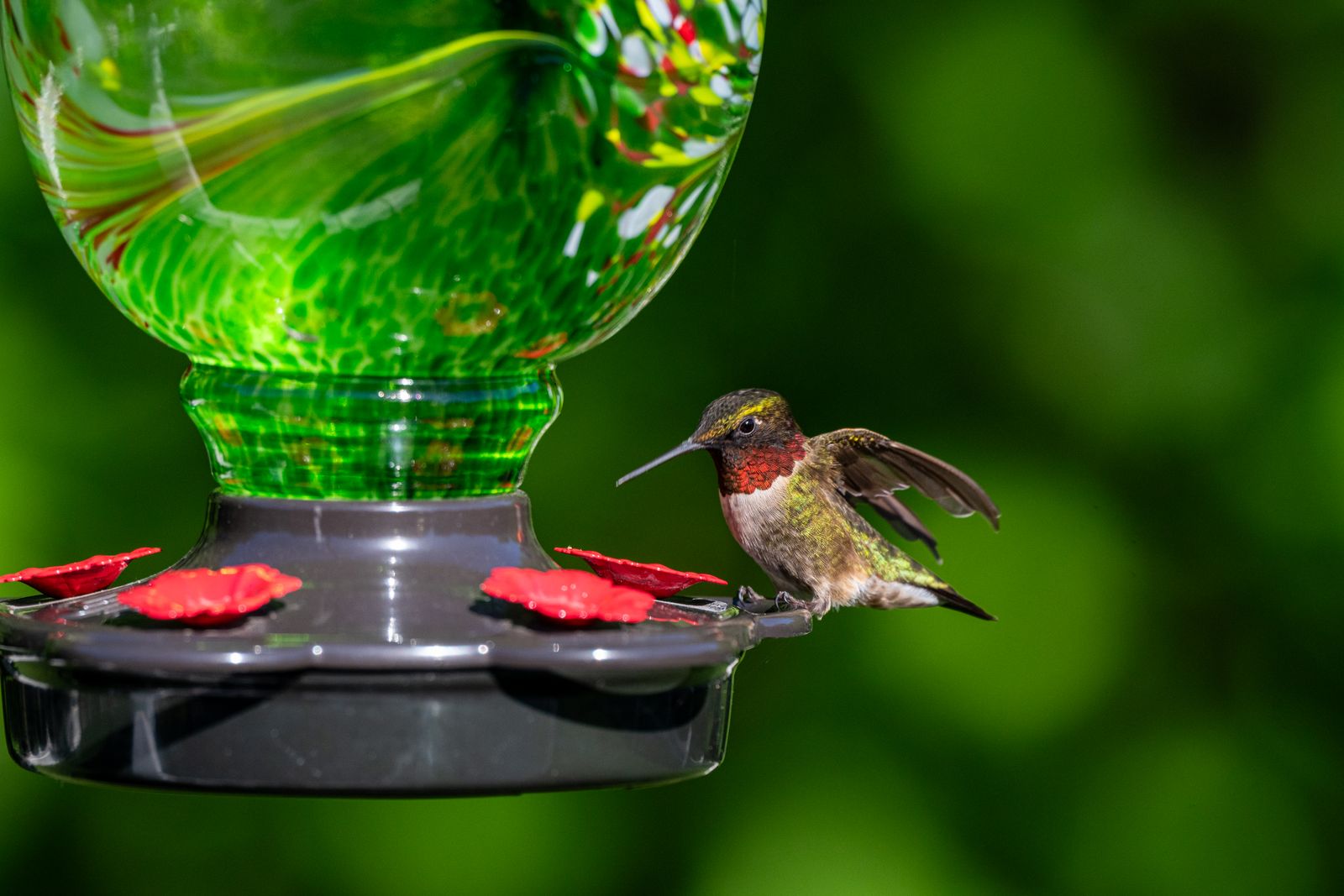
The Solar Hummingbird Feeder's reservoir comes from the second path — each piece handcrafted by glass artists working in a tradition passed down through generations, with the colorful translucent glass letting you read the nectar level at a glance.
What you are actually paying for
| Dimension | Hand-blown artisan glass | Mass-produced molded plastic | |---|---|---| | Cost driver | Skilled labor per unit | Tooling, amortized over volume | | Uniqueness | Every piece differs | Every piece identical | | Design intent | Object to keep and display | Functional item to replace | | Expected service life | Years, limited by impact risk | A few seasons, limited by sun and wear | | Repairability | Base and cap parts can be replaced; glass cannot be mended | Usually replaced whole | | Material end of life | Glass is inert and widely recyclable | Mixed polymers, often not recycled in practice | | Aesthetic aging | Color stays true; glass does not degrade | Yellowing, chalking, brittleness | | Failure mode | Sudden, from a drop or knock | Gradual, from sun and repeated cleaning | | Ownership feel | Garden decor with a function | Utility hardware |
Read that table as a fork, not a scoreboard. If your priority is running four feeders across a large yard to reduce territorial fighting between birds, molded plastic is a rational choice and glass is overkill. If your priority is one feeder near a patio that does double duty as garden art and a light at night, the calculation reverses.
Uniqueness is a feature with practical consequences
Small variations in a hand-blown piece are not tolerance failures. They are the record of how it was made — asymmetric curves, color that pools thick near the base and stretches thin at the widest point, faint spiral marks from inflation, the occasional internal bubble.
Two of those variations do practical work:
- Wall thickness variation bends light unevenly. That is why a lit hand-blown reservoir throws moving ribbons and pools of color rather than a flat even glow. A molded part with uniform walls physically cannot do this.
- Color inside the glass cannot peel. Metal oxides melted into the material behave nothing like paint on a molded surface, which chalks and fades after a couple of summers of sun and rain.
Where mass production genuinely wins
- Price per feeder. Nothing about hand labor competes with a mold on cost.
- Impact tolerance. A plastic feeder survives a fall from a deck rail. Glass on stone does not.
- Weight. Light plastic hangs from thin branches and small hooks that could not safely carry a full glass reservoir.
- Coverage. Spreading several cheap feeders around a yard out of sight of each other lets more birds feed than one premium feeder can.
- Rough placements. Gates, busy walkways, and areas where children play are all better served by something replaceable.
Where artisan glass genuinely wins
- Cleanliness over years. Glass is non-porous and does not accumulate brush scratches, so mold has far less to grip after a hundred washes.
- Nectar visibility. Translucent glass shows cloudy nectar from a distance; tinted plastic hides the same problem.
- Light quality at night. Uneven glass plus in-glass color produces color and pattern that molded housings cannot.
- Stability in wind. Real mass means less swinging and less spilling.
- It looks like something. A hand-blown reservoir reads as garden decor even in daylight with the lighting off.
A decision framework in five questions

Photo by Veronika Andrews on Pexels
The cost picture over several seasons
Artisan glass costs more up front, and the honest way to think about it is not "it pays for itself." It is that the two objects fail differently. Plastic degrades on a schedule — scratched interior, dulled exterior, sun-stiffened parts, a port that no longer seals — and most owners replace it every few seasons. Glass does not degrade at all, but a single hard knock ends it.
So the value question is really about placement risk. In a stable, protected spot, a glass feeder is a long-term object. In a high-traffic spot, it is a short-term object at a premium price. Choose the spot before you choose the material.
For a closer look at how the two materials hold up cosmetically and structurally, the comparison of hand-blown glass versus plastic hummingbird feeders goes further into durability specifics.
Frequently asked questions
Are artisan glass feeders harder to clean than plastic ones? They are easier. Glass is smooth and non-porous, so residue and mold have little to hold onto, and it does not pick up the micro-scratches a brush leaves in plastic. The one rule to observe is thermal shock: use hot tap water rather than boiling water, and do not shock cold glass with a sudden temperature jump.
Do handmade feeders come with parts you can replace? The consumable parts on a solar feeder are the cap and base assemblies rather than the glass. Ask any seller which components are available separately before buying, and keep the original packaging for off-season storage. The glass body itself cannot be repaired if it breaks.
Will a mass-produced feeder attract the same number of birds? Yes, if it is the same color, kept as clean, and filled with the same one part sugar to four parts water. Birds respond to color, port design, freshness, and location — not to how the reservoir was formed. Nearby blooms matter as well, which is the subject of live nectar plants versus glass solar feeders.
Is glass the more environmentally sound choice? Glass is inert, widely recyclable, and lasts indefinitely if not broken, which compares favorably with mixed-polymer feeders that are usually thrown away. The larger factor is replacement frequency: whichever feeder you keep longest is the better outcome.
A practical next step
Walk your garden at dusk and pick the spot first. Look for stable support, several hours of unobstructed midday sun for the solar cap, a darker backdrop so color reads at night, and a clear view from wherever you sit or stand indoors. If one spot checks all four boxes, that is where artisan glass belongs. Fill the remaining locations with inexpensive feeders.
Cover photo by Chris F on Pexels.