How Many Hummingbird Feeders Should You Run, and How Far Apart?
Most yards are well served by one feeder, and a second one earns its place only when the first is busy enough that birds are waiting or crowding. When you do add feeders, put them out of sight of one another rather than side by side, and count the extra cleaning and refilling before you buy. Two feeders is twice the upkeep, not a small addition.
When does a second feeder actually help?
Add one when the first feeder runs dry faster than you can comfortably keep up with, or when you regularly see birds arriving and leaving without drinking. Those are the two signals that the site has more demand than one station can absorb.
Adding a second feeder for any other reason usually just spreads the same visitors across two reservoirs. That halves the traffic at each one, doubles the number of things you have to clean, and makes it harder to notice when a feeder needs attention, because neither empties quickly enough to prompt you.
There is also a cosmetic reason people add feeders, and it is legitimate. Two illuminated glass feeders on either side of a seating area read as a designed pair rather than an accessory. If that is the goal, own it as a design decision and plan the upkeep accordingly.
How far apart should feeders be?
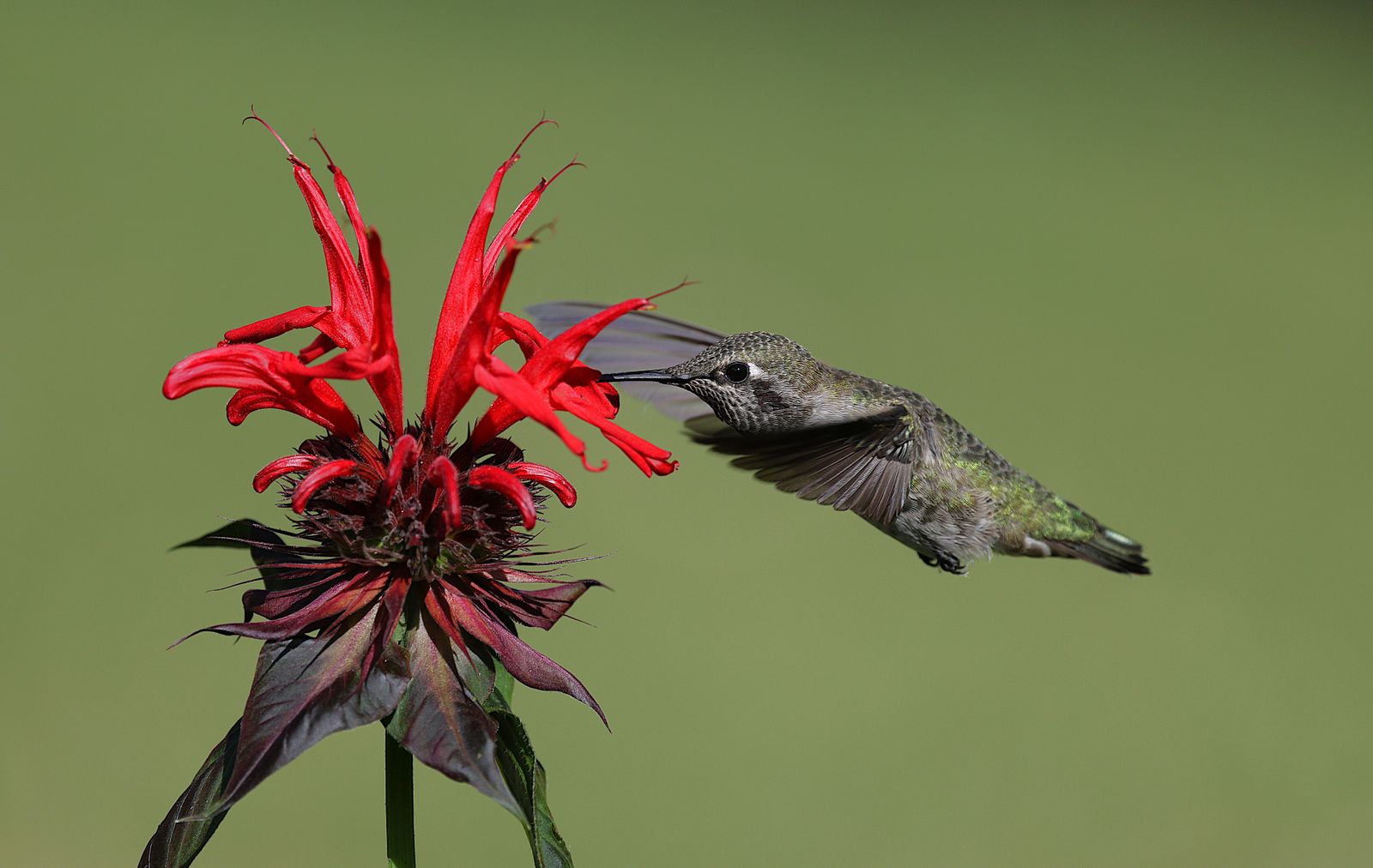
Photo by Veronika Andrews on Pexels
Far enough that a bird at one cannot see the other. In practice that means using the garden's structure: opposite sides of the house, either side of a hedge, front yard and back yard, or one at each end of a long courtyard with a planting bed between them.
Distance measured in feet matters less than the sightline. Two feeders thirty feet apart across open lawn behave like one contested station. The same two feeders fifteen feet apart with a shrub between them behave like two independent ones.
| Layout | Sightline | Practical result | |---|---|---| | Two feeders on one hook | Full | Effectively one station, more spilling | | Both on the same open patio | Full | Traffic splits, little benefit | | Opposite ends of a bed, screened by planting | Blocked | Two working stations | | Front and back of the house | Blocked | Two working stations, longer refill walk | | Different levels, balcony and ground | Partial | Usually works, watch the drip path |
What the second feeder costs you in upkeep
The honest arithmetic looks like this for each additional feeder you hang:
- One more reservoir to empty, wash, and rinse on the same schedule as the first.
- One more batch of nectar to mix, using one part plain white sugar to four parts water.
- One more set of ports to check for residue and blockage.
- One more mount to inspect for lean, drip, and wear.
- One more location whose sun exposure decides how quickly nectar spoils.
Capacity changes the math in your favor. A reservoir with a 32 fl.oz capacity holds enough that a single feeder can serve a moderately busy yard without daily topping off, which is often a better answer than two smaller ones. Check the level through the glass rather than by lifting, and you will know whether demand genuinely justifies a second station.
Matching feeder count to yard size
- Balcony or small courtyard: one feeder. There is rarely a sightline break available, so a second one adds work without adding capacity.
- Typical suburban yard: one to start, two if the first empties quickly. Use the house or a hedge as the screen.
- Large or heavily planted garden: two or three, placed at genuinely separate destinations rather than clustered near the door for convenience.
- Long, narrow garden: two work well, one at each end, because the length itself provides the separation.
Should the feeders match?
For a paired display, matching feeders look deliberate and make maintenance simpler, since one cleaning routine and one refill volume covers both. Hand-blown glass reservoirs vary slightly from piece to piece because each one is shaped individually, so a matched pair still reads as a pair without looking mass-produced.
Mixing styles has its own logic if the two locations are different in character. A larger feeder at the main viewing spot and a smaller one at a side path is a reasonable split. Just avoid mixing so much that each feeder needs a different nectar volume, a different cleaning approach, and different spare parts.
Material choice also affects how a second feeder ages, especially if it lives in a harsher spot. The aesthetic and durability trade-offs between hand-blown glass and plastic are worth weighing for the secondary location, which often gets less attention than the primary one.
A step-by-step way to decide
Keeping two feeders on one routine
Do both feeders in the same session, always. Carry a single mixed batch of nectar out, empty and wash both reservoirs, refill both, and check both mounts. Splitting the job across days is how one of them quietly falls behind.
Keep the schedule tied to weather rather than the calendar. In hot stretches, nectar needs changing more often at both stations, and the feeder in the sunnier spot sets the pace for the pair. Use water only in any ant moat, and never add red dye, honey, or brown sugar to the nectar at either feeder.
FAQ
Is two feeders always better than one? No. Two feeders only help when a single one cannot keep up with demand. Otherwise the same birds split between them and you double the cleaning for no gain.
Can two feeders hang from the same hook? They can physically, but they behave as a single station and drip onto the same patch of ground. If you want two working feeders, separate them so a bird at one cannot see the other.
How far is far enough? Whatever distance puts a visual barrier between them. A shrub, wall, or corner of the house does more than raw distance across open ground.
Does a second feeder need the same sun exposure? It needs enough daylight if it charges a solar cap, and ideally some afternoon shade to slow nectar spoilage. A second feeder in deep shade will light for less time and still needs the same cleaning schedule.
Where to start
Run one feeder properly for a fortnight and write down how often you refill it. That single number tells you more about whether to add a second than any general rule, and it costs nothing but two weeks of watching.
Cover photo by Veronika Andrews on Pexels.