Hand-Blown Glass vs. Plastic Feeders: Enhancing Aesthetics and Attracting Hummingbirds
Hand-blown glass and molded plastic hummingbird feeders hold the same nectar, but they age very differently and they look nothing alike in a garden. Glass keeps its clarity and shape through years of sun, which matters because the sealing rim staying true is what keeps a feeder from dripping. Plastic is lighter and cheaper and shrugs off drops, but it clouds, scratches, and can distort in heat. Neither material changes how many birds visit on its own; nectar freshness and placement do that.
Which material do hummingbirds actually prefer?
Neither, directly. Hummingbirds respond to color, motion, a reliable food source, and safety. What they cannot evaluate is whether the reservoir is borosilicate or polystyrene.
Material matters to birds only through second-order effects, and those effects are real:
- A reservoir you can see through makes cloudy nectar and mold obvious, so it gets caught early.
- A rim that holds its shape keeps the seal tight, so nectar stays clean inside instead of fermenting in a puddle on the ground.
- A surface that stays smooth after repeated brush cleaning is easier to get genuinely clean.
- A reservoir that does not haze keeps colorful, translucent glass visible, and color is one of the cues birds use to find a feeder.
How the two materials compare, point by point
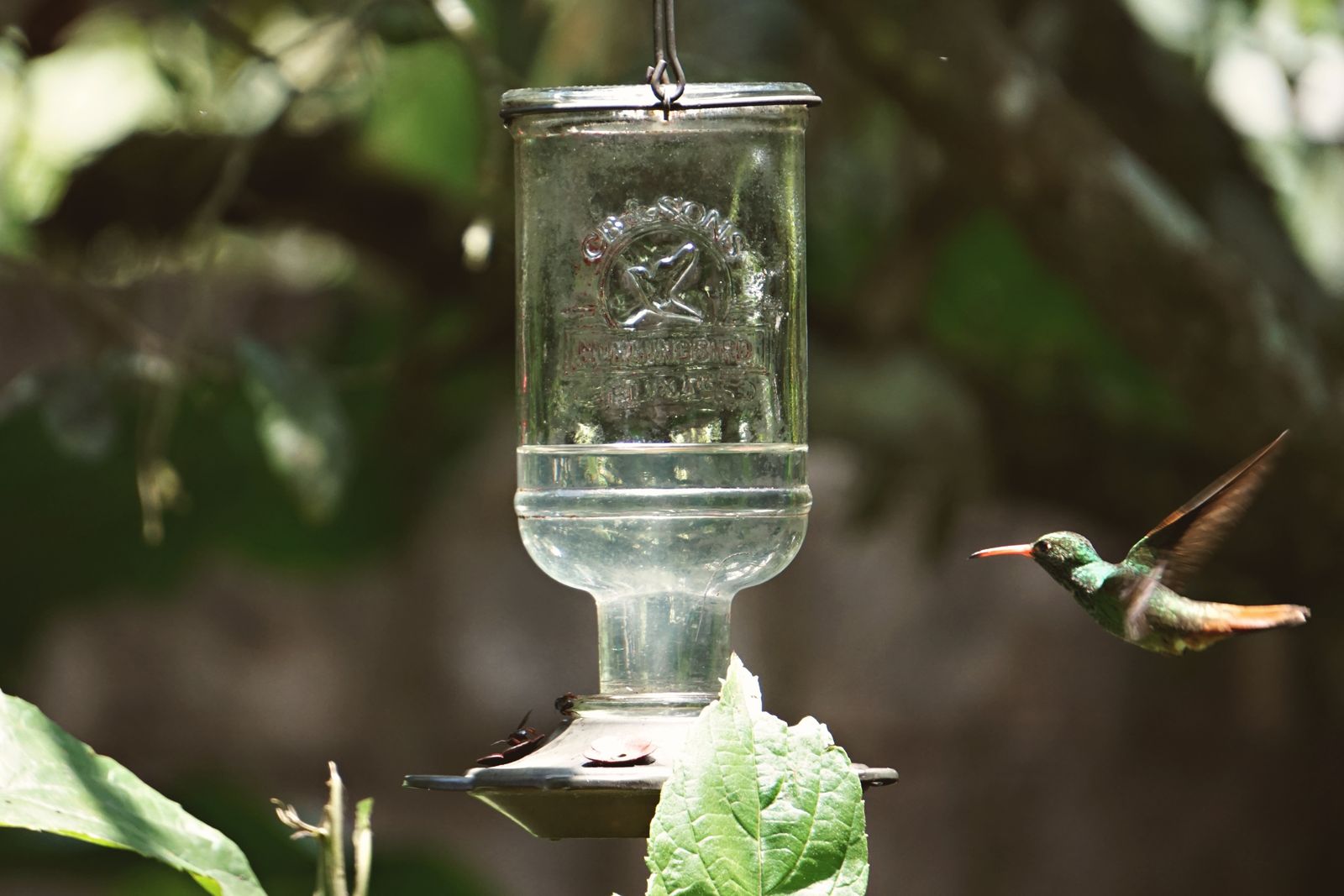
Photo by DΛVΞ GΛRCIΛ on Pexels
| Factor | Hand-blown glass | Molded plastic | |---|---|---| | Clarity over time | Stays clear; nectar level readable for years | Often yellows or hazes with sun exposure | | Shape stability in heat | Holds its form, so the sealing rim stays true | Can soften or distort, which starts slow leaks | | Scratch resistance | High; survives bottle-brush cleaning | Scratches easily, and scratches trap residue | | Impact resistance | Can break if dropped or knocked off a hook | Very forgiving of drops | | Weight | Heavier, needs a solid hook or bracket | Light, works on modest hangers | | Appearance | Reads as garden art; each piece is unique | Reads as equipment | | Behavior with light behind it | Translucent glass glows when lit | Diffuses light unevenly, often dully | | Typical cost | Higher | Lower |
Why does glass hold up better in direct sun?
Ultraviolet light and heat are what age outdoor objects. UV breaks down polymer chains in many plastics, which is what produces the chalky, yellowed look on an old feeder, and heat can let thinner molded parts creep out of shape under load. Glass is essentially inert against both. It does not photodegrade and it does not soften at any temperature a garden reaches.
The practical consequence shows up at the seal. A feeder holds nectar upside down because trapped air and the liquid column stay in pressure balance, and that only works if the base seals completely. A rim that has bowed by a fraction of a millimeter lets air in, the balance collapses, and nectar runs out under gravity. Feeders that "started leaking after two summers" are usually telling you about a warped rim or a tired gasket, not about a design flaw. The longer treatment of how glass and plastic differ on aesthetics and durability goes further into how each material ages outdoors.
What hand-blown really means, and why it changes the look
Hand-blown glass is shaped by a person rather than pressed into a mold. On the feeder sold here, each reservoir is handcrafted by glass artists working the material at around 2,300 degrees, shaping the curves and patterns individually. The technique is generations old, and the result is that no two reservoirs are identical.
Two things follow from that. First, small variations in wall thickness, swirl, and color placement are characteristics of the process, not defects. Second, the piece behaves like decor. Colorful translucent glass catches daylight, and when a solar cap lights it from above after dark, the whole reservoir glows rather than just the lamp.
Molded plastic gives you consistency instead. Every unit looks like every other unit, which is exactly what some buyers want, especially for a feeder that will hang somewhere rough or get handled by kids.
Where plastic is genuinely the better choice
There is no point pretending glass wins everywhere. Plastic is the sensible pick when:
- The feeder will hang in a high-traffic spot where it will get knocked.
- The mounting point is weak, such as a thin branch or a lightweight suction hook.
- The feeder is one of many in a large yard and cost per unit matters.
- Children handle refills, or the feeder gets moved constantly.
- Winters are harsh and you would rather risk an inexpensive item outdoors.
Cleaning and care differences that matter in practice
Both materials need the same routine, but they tolerate it differently. Empty, wash, and refill every few days, and more frequently in hot weather or any time the nectar looks cloudy or shows dark specks. Use hot water and a bottle brush, scrub the ports and the sealing surfaces, and rinse well. Mold in sugar water is a real health hazard to hummingbirds, which is why this is the part of feeder ownership that cannot slide.
Glass takes vigorous brushing without marking, so it comes back genuinely clean each time. Plastic accumulates fine scratches, and those scratches hold biofilm that a brush skims over rather than removing. Over several seasons, that difference compounds: an old plastic reservoir is harder to sanitize than an old glass one, even with identical effort.
Nectar itself is the same in either: one part plain white granulated sugar to four parts water, stirred until dissolved and cooled before filling. No red dye, no honey, no brown sugar, no artificial sweeteners.
Does the reservoir material affect how long nectar stays fresh?
Temperature drives spoilage far more than material does. A feeder in full afternoon sun will spoil nectar quickly whatever it is made of, and a feeder in dappled shade will hold longer. Placement is the lever.
Where material helps is in detection rather than prevention. A see-through reservoir shows you cloudiness, strands, and specks before birds have been drinking spoiled nectar for a day. A hazed or opaque body hides all of that. A slender, sealed design also limits the surface where nectar sits exposed at the ports, which reduces both drips and the insects those drips invite.
If you are thinking about the whole yard rather than just the hardware, feeders and plantings do different jobs, and this comparison of nectar plants against glass solar feeders is a useful next read.
FAQ
Will a glass feeder crack in freezing weather? Liquid expanding as it freezes can stress any sealed container, so the sensible practice with any feeder is to bring it in before a hard freeze. In most regions hummingbirds have moved on by then anyway, and storing the feeder indoors protects the finish, the gasket, and the solar cap as well.
Is hand-blown glass heavier than it needs to be? It is heavier than plastic, and a full 32 fluid ounce reservoir plus the base is real weight. That is a hardware question rather than a material objection: use a proper shepherd's hook or bracket rather than a light branch or a stick-on hook.
Do small bubbles and thickness variations in the glass mean it is flawed? No. Those are signatures of glass shaped by hand at high temperature. Uniformity is what a mold produces; individuality is what hand-blowing produces.
Which material is better for a lighted feeder? Translucent glass, because light passing through it illuminates the whole reservoir and the nectar inside. That is the effect a lighted feeder is bought for, and cloudy or opaque plastic mutes it.
A practical next step
Decide based on where the feeder will hang rather than on the material in the abstract. If the spot is visible from where you sit, secure enough for real weight, and you want to keep the feeder for years, buy glass and hang it on a solid hook. If the spot is rough, exposed, or temporary, buy plastic and plan to replace it when it clouds.
Cover photo by Skyler Ewing on Pexels.